
by Alderney Bird Warden | Nov 13, 2020
PART 1. Seabirds
The ABO was able to make a significant return by way of our annual contribution to the States of Alderney RAMSAR program despite the obvious difficulties that this year presented.
Our observatory–led seabird ringing research trips have been extremely popular with UK bird ringerssince the ABO began leading this part of the program in 2016. The seabird ringing program on Alderney and its offshore islets began in 1945, undertaken for the Channel Islands Bird Ringing Scheme almost exclusively by bird ringers travelling from Guernsey to complete this important research work.
Alderney has had its own resident bird ringers qualified to manage the programme through the ABO since 2016. We have strived to develop and refine methods and best practice for obtaining data and minimising disturbance of our seabird colonies with each passing year.
Increasing numbers of UK ringers now travel to Alderney annually to assist with this work adding skills and experience to the wealth of knowledgecontributed by Channel Islanders.
Each of the scheduled trips for 2020 was fully booked with licenced bird ringers, an exciting, rich mix of experience and enthusiasm set to gather data in researching and understanding our seabird colonies. Alas Covid-19 saw forced blanket cancellation of our visiting bird ringers from the UK. Things looked bleak in terms of any offshore seabird ringing for this ill-fated year.
However, we were able to adapt and complete some of the most important elements of the RAMSAR seabird ringing program thanks to the small team of Channel Islands-based ringers.
The ringing of Gannet chicks on Les Etacs has been carried out by representatives of the Channel Islands Bird Ringing Scheme almost annually since 1945. Thelocal seabird ringers who have completed the task many times expressed a feeling that it is no longer safe for bird ringers to climb this rock due to the density of the colony and size of the nests.
A review of how to ring Gannet chicks on Les Etacshas been suggested and options to improve the safety of birds and ringers are being considered. Tons of nylon fishing gear is taken to the colony with seaweed nesting-material each season. Chicks and adults get caught in it and the team is often able to free them during the visits, making them all the more useful.
Ortac to the west of Les Etacs is home to a slightly smaller Gannet colony which is altogether a much easier proposition. Although landing can be tricky,moving around the rock is significantly easier.
Sadly, the timing of a local virus lockdown on Alderney prevented us visiting Little Burhou to ring the Cormorant colony. Visiting Ortac and the small auk colony on Coq Lihou were sacrificed this year in favour of pooling all available resources into a focussed effort ringing the Storm Petrel and Lesser Black–backed Gull colonies on the Island of Burhou.
More than 500 Storm Petrels were ringed over two consecutive nights, 17 and 18 July. The first-choicesite for ringing Storm Petrels if conditions allow is at the north–east end of the island at a dedicated location where just two 18-meter nets are deployed.This long-established site allows continuity of annual records and data returned.
The first Petrels begin to arrive soon after dusk (around 10:15pm) on the first night. This is a large colony, and two nets are quite sufficient to keep a team of five experienced ringers employed until 4am when we finish about an hour ahead of dawn. We processed 254 new birds, 29 local retraps and two overseas controls this year.
The weather conditions were good on the second night and we moved a short distance to the other dedicated location in the north west corner of Burhouagain to obtain valuable long-term data. Redeploying our nets we processed 259 new birds, 42 local retrapsand again two foreign controls. The winds began to get up around 3am and the decision was made to finish a little ahead of schedule.
A total of 588 Storm Petrels were processed, 513 new birds, 71 re-traps and 4 foreign controls (three UK and one French) over the two nights.
The first bird to be ringed, however, was a single Rock Pipit. This species does exceptionally well breeding on Burhou. There are well in excess of 50 individuals present in July each year. Rock Pipit is a species that has received precious little international research attention resulting in minimal baseline data. One scientific authority even referred to it as ‘The Grey Man’ of British birds.
Undoubtedly there is local dispersal of Rock Pipits across the Channel Islands besides the more significant migration movements. Though not a rare bird, it is arguably as important to understand why a species is doing well as it is to learn why they may be in decline. The ABO had a request to study these birds rejected by the Alderney Ramsar committee and we hope that a new independent panel of experts, set up to oversee all aspects of conservation and wildlife on Alderney, will recognise the opportunity to obtain data on these ‘forgotten’ birds.
Exciting news received by the Channel Islands ringing scheme this year was of a Storm Petrel ringed on Burhou, 20 July 2014, by Guernsey’s Chris Mourant. The bird was recorded alive and well 382km north during a ringing session on 22 July 2020 at Bardsey Bird Observatory (Great Britain, Gwynedd, Wales). The time elapsed was 6 years 2 days.
Further birds ringed on Burhou by the ABO teams in previous years processed this year outside the Channel Islands are:
Burhou 26/07/2019
– processed 30/07/2020 at Gwennap Head, Cornwall, Great Britain
Burhou 27/07/2019
– processed 19/06/2020 at Plemont Point, St Ouen, Jersey, Channel Islands
This year’s four foreign controls (birds processed on Burhou this year originally ringed outside the Channel Islands) are as follows:
Burhou 18 July
– originally ringed 26/06/2019 – Portland Bill, Dorset, UK – – ~ originally ringed 06/07/2019 – Gwennap Head, Cornwall, UK
Burhou 19 July
– originally ringed 01/08/2019 –Skokholm Island, Pembrokeshire, UK ~ originally ringed 05/06/2018 – Le Conque, Finistère,
In terms of longevity, the oldest birds re-trapped were two individuals originally ringed on Burhou in 2006.
Not wanting to waste precious time on Burhou, the team got on with colour–ringing chicks in the Lesser Back–backed Gull colony during daylight. This was my fifth year observing the productivity of this species and there was little doubt that a bumper year was in progress. In one small area of the colony where we have previously processed a maximum of 20 chicks in a good year, we found 47 birds.
There was, however, evidence of a marked increase in casualties with eight deceased chicks in the same area where in previous years we have recorded a maximum of three. There were fewer addled eggs located this year, only four. Overall, more birds were closer to free flying indicating that the dates for this research work should not be extended (if this is to be considered an average year). It was too hot during the day and scheduled work in the Gull colony wasdelayed until late afternoon rather than risk exposing chicks to the sun.
Combining the Gull and Petrel research was a great success given the difficulties arising from the COVID-19 situation.
Having considered disturbance of the colonies the ABO recommends the combined approach of a single Petrel / Gull visit as preferable. Indeed, a three–night effort would be ideal in terms of gathering data on these two target species. The benefits of less disturbance in a single visit were clear.
Being able to ring Storm Petrels on two consecutive nights was unusual. Winds often prevent ringing in exposed sites. An extra night would greatly improvethe chances of a good annual data return. It will be interesting to see the Gull population estimates from this year’s RAMSAR officer given our teams’observations and colony size estimates.
Two Herring Gull chicks and two Shag chicks were chanced upon and ringed. A further Lesser Black-backed Gull chick that wandered into our camp HQ on 19th was also ringed.
Field observations of passing migrants included a Honey Buzzard, Grey Heron and Common Sandpiper.
The accommodation hut on Burhou – Photo, Dan Scott

Burhou Island just NW of mainland Alderney
Other seabirds ringed on Alderney outside the RAMSAR site this year were two Herring Gull chicksand 28 Storm Petrels (22 new, 6 retraps).
Our mainland Alderney Storm Petrel ringing efforts produced the earliest record of the species (22 May2019). This year we continued to look at Petrel arrival dates and despite efforts from mid-May in good conditions our first birds were processed on 15 June.

Storm Petrel ringing on Alderney’s NE coast. The amount of white on the underwing can often determine the sex of this species, in this case above, substantial white indicates a male. Photo JH.

by Alderney Bird Warden | Jun 5, 2020
The first half of May usually sees less in the way of volume of birds passing through the island but usually more diversity that includes rare and scarce records to add to our data. Last year during these two weeks we recorded Alderneys first Thrush Nightingale. As you can see from this blog, this May certainly held some surprises. Breeding birds are in full swing and we hope to bring you news of a first breeding for Alderney in next months blog, for now we can reveal no further information as the welfare of the birds must come first, we want to give them every chance of success. A very good summary of Bailiwick wildlife law and clear guidance in terms of disturbing nesting wild birds at this time of year can be found on Guernseybirds website. This May also saw our assistant warden Elliot achieve a new record for most species recorded in Alderney in a single day with 79 different species spotted on the 8th of the month.
The single male Teal remained until the 19th, it appears he has some identity issues as he has been observed trying very hard to win the attentions of female Mallards. 35 Common Scoter were seen during a sea-watch on the 26th along with 3 Storm Petrels, 23 Manx Shearwaters and 1 Balearic Shearwater, of the latter also 3 on the 20th and 1 on the 22nd. Only our 2nd record (since 2016) of Quail was recorded calling from a meadow at Fosse Herve on the 31st. A memorable spring for birds of prey continued with a first record for The Channel Islands of Bearded Vulture. This magnificent bird was found and photographed by ABO board member Neil Harvey on the 19th with a couple of other lucky locals also noticing this gigantic bird and taking photos using their mobile phones. Though it was thought that the vulture departed high and to the north at 3pm, the following day it was again spotted, this time high over the Bird Observatory descending towards the lighthouse where it turned south west and out across the sea towards France. The bird had no signs of any transmitter, tagging, feather bleaching or rings and is likely wild born from captive released parents as part of the International Vulture Foundation re-introduction program of these birds to the Pyrenees and Alps. Just two posts on the ABO twitter page of this bird attracted over 150,000 views! The photograph below has subsequently featured in local and national newspapers, BBC & ITV news broadcasts and on BBC Countryfile.
Bearded Vulture (and Crow) over Mannez lighthouse – photo – John Horton
A chastened Osprey flew low over the war memorial headed NE on the 31st. After recording Black Kites into double figures in April, there were two May records; over Essex Hill on the 2nd and on the 12th over Burhou Island. Also on the 12th an adult female Hen Harrier was hunting at Kiln Farm. Hobby was recorded on 6 separate dates involving a total of 8 birds. A Merlin passed over Mannez on the 7th. 5 Honey Buzzards were recorded between the 8th & 21st. On the 8th came our 2nd Black winged Kite of the spring (and no we couldn’t believe it either) some 16 days after the April bird this one appears to be a 2nd calendar year and was quite settled along the west coast where it spent the best part of 3hrs.
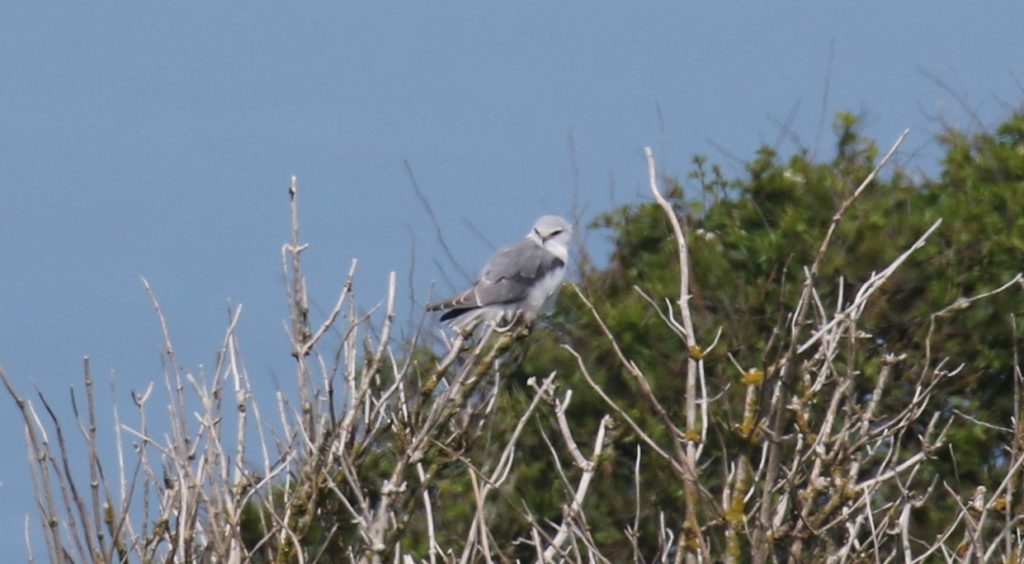
Black-winged Kite – Bonne Terre valley & west coast – photo – John Horton
A Greenshank was in Longis Bay on the 19th. Common Sandpipers were thin on the ground this year with only 7 individuals recorded, all during the first week of the month. Two 2nd calendar year Yellow legged Gulls were in Longis Bay on the 11th. Pomarine Skua was seen offshore on the 2nd and on the 20th. A female Nightjar was hunting over Longis common at dusk on the 15th and a male was heard calling in a garden in St. Anne on the 19th. The Hoopoe ringed on the 26th of last month was still at Longis reserve until the 4th, likely the same bird was seen at Kiln farm on the 6th. Two vocal Bee-eaters flew over Mannez reserve on the 7th, they only hung around for a couple of minutes before heading out to sea to the NE.
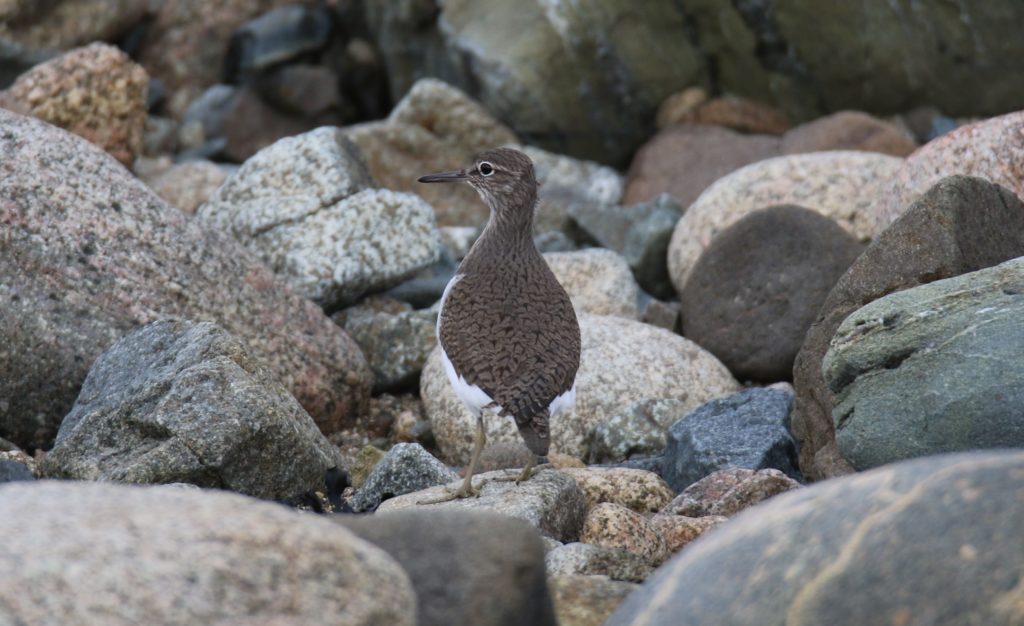
Common Sandpiper – Saye Bay – photo – John Horton
Cuckoo was recorded on 8 different days. Just two Turtle Dove records this spring, 1 on the 1st in St. Anne allotments and another over the NE of the island on the 8th. Swifts moved through in small numbers throughout the month with a high count of 20 on the 25th. Migrating Tree Pipits were recorded almost daily until mid month. Single Blue-headed Wagtails were at Whitegates fields on the 2nd and 12th, the high count of Yellow Wagtails was a flock of 22 on the 12th. An estimated 1200 Swallows gathered over Longis reserve on the evening of the 15th, about two thirds moved off to the north east about an hour ahead of dusk. A Wheatear was observed feeding a chick on the 14th, this species has successfully bred on Burhou island in recent years but I am struggling to find any mainland Alderney records of the same. A rare spring record of Mistle Thrush (migrant only here) was on Longis Common on the 16th. A female Pied Flycatcher ringed at Mannez on the 12th is our latest spring record to date. Spotted Flycatcher records involved 12 birds between the 1st & 25th. The last of 3 Common Redstarts was spotted on the 12th. A Nightingale ringed at Mannez on the 3rd was in good voice at the same location on the mornings of the 4th & 5th but not after. A very rare spring record and new for Alderney was a Radde’s Warbler spotted by assisstant warden Elliot on the 3rd along the railway sidings close to the waterworks, the bird was calling and showed briefly but well. Single Lesser Whitethroats were on the 2nd & 3rd. A fine spring plumage Rose-coloured Starling was moving with around 40 Common Starlings between the Fosse Herve fields and adjacent residential gardens on the 31st. Three Serin records were of a female at Val du Sud on the 3rd, a male on the campsite on the 12th, and another over the golf course on the 17th. 4 Common Crossbills were seen flying over Essex farm on the 14th.

Rose-coloured Starling – Fosse Herve – photo – John Horton
Moth trapping has had a slow start but cught up with some bumper sessions towards the end of May with over 30 Small Elephant Hawkmoth and 66 Cream spot Tiger moths over 3 nights.
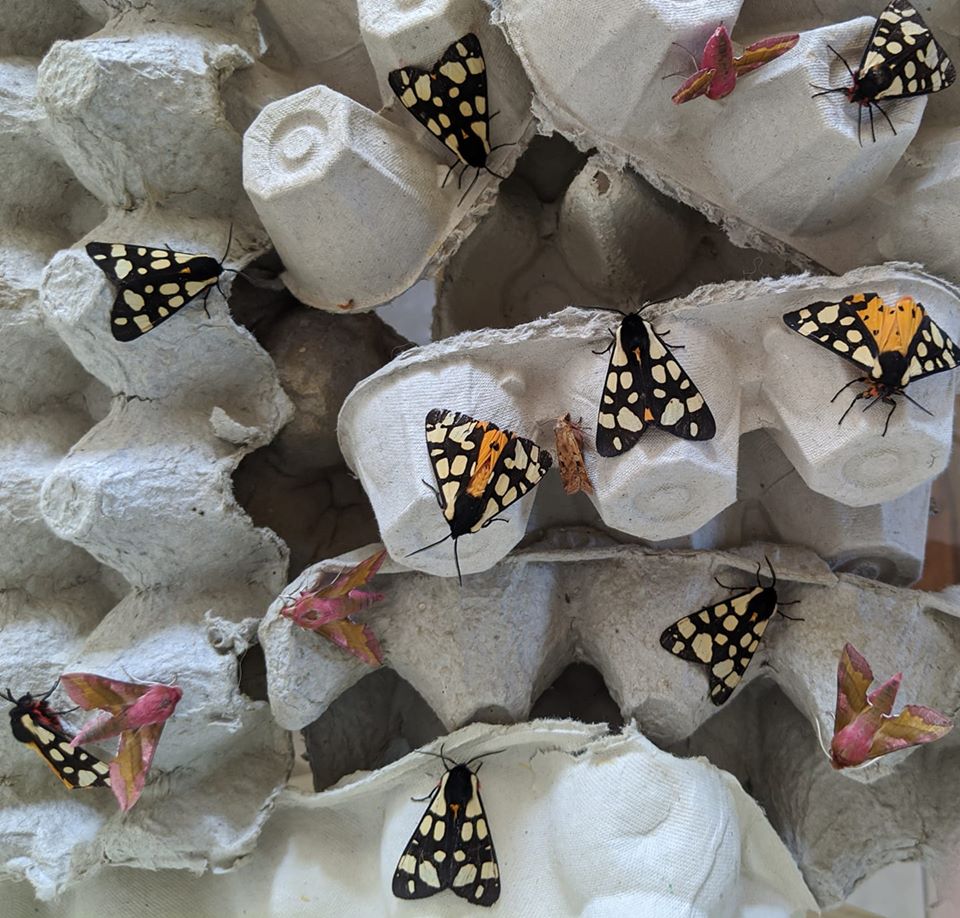
ABO moth trap contents 28th May- photo John Horton

by Alderney Bird Warden | May 7, 2020
During lockdown Elliot and I have made good use of our 2hrs exercise completing the census walk, a relaxation of the restrictions locally allowed us to obtain permission to resume bird ringing and have unrestricted census time from the 25th. The last two weeks of April are always a productive and exciting period for us here recording migration and this year didn’t disappoint. On the 23rd Paul Veron found a Canada Goose near the airport, a local rarity. On the 18th, 6 Dark bellied Brent Geese offshore were probably our last spring record for this year. Two pairs of Common Shelduck appear to have settled at the north east end of the island and the male Teal remained present to month end. Single Manx Shearwaters were seen off the NE coast 19th & 21st. Black Kite was present on 8 seperate days between the 18th & 30th, with 2 seen together on the 25th. From photos of individual birds it looks like one of them (most unusually) hung around for a week and that the period saw 4 or 5 individual birds in total. A female Marsh Harrier passed through on the 23rd and a 2nd calendar year Hen Harrier showed well over Whitegates fields 21st. Hobby was seen on the 19th & 25th and a Merlin 21st.
Hen Harrier – Whitegates – Photo – JH

Black Kite – South Cliffs – photo – Elliot Monteith
Water Rail was recorded up to the 26th sparking hopes of the repeat breeding of 2016. 4 Lapwing were reported from the Bonne Terre valley 21st. Other wader sightings included a Greenshank in Longis Bay on the 25th, a smart summer plumage Grey Plover 25th & 26th. A high count of 13 Dunlin on the 28th, Green Sandpiper showing well at Mannez reserve on the 21st, 4 single records of Bar-tailed Godwit (19th-28th) 2 Snipe on the 22nd and on the 30th a high count for this reporting period of 17 Whimbrel.

Grey Plover – Saye Bay – photo – JH

Whimbrel – Mannez Lighthouse, photo – JH
A dark phase Arctic Skua was spotted on the 19th and at least two immature Yellow legged Gulls regularly visited Saye Bay. The 18th brought an ‘observatory list’ (2016 onwards)first record as Elliot recorded a summer plumage Black Tern just offshore on the north east coast. A female Hoopoe ringed at Longis reserve on the 27th was still around on the 30th but very elusive. The 21st saw our first Swift movement with 19 recorded. On the 21st Elliot had brief views of a Red-rumped Swallow, a species I had expected to record before now, this the ABO’s first record although they have been recorded in the Channel Islands annually in recent years.

Hoopoe – Longis reserve- photo – JH
On the 27th a Tree Pipit trapped at Longis reserve was wearing a Portuguese ring, this transpired to be the first time this species has ever been found sporting a ‘foreign’ ring in the Channel lsands, 8 Tree Pipits were spotted on the 18th and on the same day 17 Yellow Wagtails. On the 22nd at least 6 Common Redstarts were present in the census area and a female Pied Flycatcher was at Longis 30th. 38 Wheatears were counted on the 24th, single Whinchats 23rd & 24th and single Ring Ouzels 23rd & 25th. The first Garden Warbler this spring was on the 23rd and first Wood Warbler the same day. 3 Lesser Whitethroats were seen towards the month end including one ringed on the 25th. The remaining Fan-tailed Warbler at Longis reserve was ringed on the 19th and was present singing and displaying daily to the 30th.

Fan-tailed Warbler – Longis reserve photo – JH
We added Small Copper, Orange-tip and Painted Lady to species of butterfly recorded within our census area, and 6 impressive Emperor moths on the 25th.
The ABO led Bailiwick Garden Birdwatch was a great success and results will appear of the ABO social media pages tomorrow. Thanks to all those who took part.
The local Bailiwick islands newspapers and social media had done us proud publishing our article on Gannet behaviour see https://guernsey.com/news/2020/05/05/birdwatchers-notice-gannets-behaviour-change-due-to-virus/ Also the ABO twitter feed blog page achieved some great publicity for Alderney with an amazing 34,686 views at the time of posting this blog.
Lastly, other welcome news is our observatory field centre accommodation has just received our ‘Quality in Tourism’ certification awarding us 4 STARS! We are enormously proud to have achieved this high standard, all we need now is for you to be allowed to come and visit!
Stay safe everyone.


by Alderney Bird Warden | Apr 18, 2020
During lockdown field observations have been somewhat limited with just Elliot and I the only observers spending our 2hrs exercise working independently completing the daily census as far as is possible. Alderney remains a virus free zone as I type this blog and it is a huge credit to the local authorities and community that this has been achieved to date.
Some interesting Gull ring reads in the field 20th March included 2 Great Black backed Gulls originally ringed at Portland Bill Bird Observatory. Other excellent research data was received from the Channel islands birds ringing scheme with news of a Dunlin ringed by a visiting Jersey ringer in Longis Bay Alderney in October 2016, re-trapped last year in Poland.
35 Dark bellied Brent Geese 5th Apr preceded a single on the 14th that may well be our last this spring. Common Shelduck peaked at 5 in Longis Bay 14th Apr. The male European Teal still present to at least the 18th Apr is looking very fine but may have to move on if he is to find a lady friend. Elliot spotted 2 Great Crested Grebes offshore on the afternoon of the 3rd Apr (an irregular and not annual visitor here – the Grebes that is, not Elliot). A movement of at least 22 Grey Herons passed over Alderney 5th April all headed NE.
European Teal – Longis pond – photo JH An amazing run of birds of prey began on 31st March when Elliot observed a heavily mobbed adult White tailed Eagle over the bird observatory, our last island record of this species was in 1908. Some 8 Merlins have been recorded during this blog reporting period and on the 15th April our first Black Kite this spring spent the afternoon with us having been seen in off the sea earlier that afternoon. It was great to see it perched in a tree on Longis reserve. The same day we had our first Hobby this year.

Black Kite Longis reserve – photo JH

Black Kite – Longis reserve – photo – JH A red letter day for birds of prey came on 16th April. A female Hobby rifled across Longis Common, a pair of Peregrines hunted the NE coastline and 2 Ospreys were spotted both headed north towards the UK. Pottering in my garden at the lighthouse during lockdown (bins always to hand), mid afternoon I noticed a bird that looked interesting offshore headed straight towards us. Lifting my bins only one option was immediately obvious, it was a spectacular Black winged Kite! First spotted about 100 meters out, it was one of those magical birding moments I will never forget. This is a first record for Alderney and a species not recorded on mainland UK. The bird came in very low and drifted (mainly gliding on long wings) across Mannez quarry where upon reaching the quarry edge it rose to overlook the plateau of low vegetation above where it stopped and hovered (Kestrel like) taking up 3 or 4 positions hunting during a tantalising minute or so before heading SW in the direction of the observatory about half a mile away. I was already on the phone to Elliot who charged into the observatory courtyard and managed a couple of record shot photos of the kite (good man) before it again headed SW and out of sight. My lasting memory of this event will be this Kite’s Owl like face looking straight at me as it approached dry land, and turning to my father (who is birder who was stood beside me) and squeaking the words ‘Black winged Kite’ with whom this became an even more priceless moment.

Black winged Kite – over the bird observatory Longis Bay – photo – Elliot Monteith Water Rail is still being recorded on Longis pond during our census work at least until the 16th Apr so high hopes of another breeding success for this species at this location. A single Redshank (uncommon here) was in Longis Bay 1st & 2nd Apr. Whimbrel numbers are picking up slowly with increasing single records and 3 on the 17th Apr. Yellow legged Gull sightings have involved at least 3 birds, the latest a 2nd Summer in Saye Bay on the 17th. On an exceptionally low tide 10th Apr there were 418 Herring Gulls in Braye Bay. A Common Tern fishing off the lighthouse in company with two Sandwich Terns 5th April pre-empted some interesting movements at sea on the 6th & 13th Apr. On the 6th, 11 Little Gulls, 6 Common, 4 Arctic & 23 Sandwich Terns and on the latter date 1 Little Gull, 6 Sandwich Terns and a Pomarine Skua. Our first Cuckoo this year was seen and heard on the golf course on the 10th Apr. Swallows and Martins have been coming through but not yet into 3 figures on any given day. 20 Tree Pipits have been recorded since 6th April and Elliot is bravely taking on the challenge of Yellow Wagtail sub species identification, recording 2 Blue-headed and several Channel so far with a single day high count so far of 28 Yellow Wagtails on the 11th Apr. Our first Common Redstart of the year were 2 on the 6th April, Black Redstarts have seen 18 records this reporting window but none since the 12th. Wheatears continue to ebb and flow with 35 on the 5th Apr including 4 ‘Greenland’ birds. Our first 2020 Pied Flycather was a fine male in Barackmasters Lane 15th Apr and the first Whinchat the day after a Whitegates. The persistent east winds brought us a fall of Song Thrushes 4th April with at least 62 birds recorded (all the nominate European birds). Sporadic records of winter thrushes were trumped on the 2nd Apr with an estimated 380 Redwings and 420 Fieldfares. 11 Ring Ouzels have been seen, the lastest 2 males on the 16th Apr. First spring records were of Garden Warbler 17th Apr, Common Whitethroat & Sedge Warbler 5th Apr, Reed Warbler 10th Apr and Grasshopper Warbler reeling on the 6th Apr. Fan-tailed Warblers have become a fixture at Longis reserve since early March and certainly 3 birds were present 8th Apr. A Rook 5th Apr was only the 2nd one since the obs launched in spring 2016. 2 female Serins were at Barrackmasters lane 5th & 6th Apr.

Yellow Wagtail – Whitegates – photo -Elliot Monteith Moth trapping has been a slow start with Powdered Quaker probably our best local record thus far as this species is scarce here unlike the UK. Also a female Emperor moth in the Obs moth trap 12th April. Our 2nd Large Tortoiseshell butterfly was on the 4th April and 1st Green Hairstreak on the 12th. Sadly with the annual spring Naturetrek holiday group visit unable to go ahead I missed the delight of showing off one particular area carpeted with the Green Winged Orchid. Somehow this Palmate newt managed to get into out bird bath that is 2ft off the ground… and just about wraps up this blog leaving me only to say stay safe everybody, we hope you enjoy the ABO blog and don’t forget for all those who live in the Bailiwick the Big Garden Birdwatch week starts on the 24th April.

Palmate Newt – Mannez Lighthouse Garden – photo JH

Green-winged Orchid – NE Alderney 16th April photo – JH

Emperor moth (female) NE Alderney – photo – JH

by Alderney Bird Warden | Mar 21, 2020
A Singe Brent Goose joined a high count of 5 Shelduck in Longis Bay on the 14th and the lone male Teal remains on Corbletts quarry. Black-throated Diver was on the sea off Mannez Lighthouse on the early morning high tide on the 11th, and probably the same bird off fort Razz on the 15th. 4 Whimbrel and 5 Turnstone on fort Houme Herb 11th were the high counts for these species during this blog period. 3 Purple Sandpipers at Fort Razz on the 16th was a rare sight here adding to records of only 2 individuals since we began recording in April 2016. A Snipe seen on the 17th was surprisingly our first of the year and an indication of the very mild winter. An Osprey passed over the ABO census area on the 16th. Water Rails remain in good numbers especially at Longis pond where up to 6 make themselves heard towards dusk. A Yellow Legged Gull was spotted on the 10th and on the 19th a Bonxie offshore at Houme Herbe.

Purple Sandpiper, Fort Razz, Photo Elliot Monteith
A Barn Owl is still favouring hunting between the target wall and Longis common during calmer weather and 2 Kingfishers were confirmed on the 16th. 4 Sand Martins passed by Corbletts Bay 11th, 3 on the 16th & 12 at Longis (18th) our first Swallow was at Mannez (19th). A Black Redstart (photo below) was at the obs on the 17th on the ‘new’ roof of the old armoury building, a pair of White Wagtails were present at the same spot surveying it for nesting opportunities. No large movements of Wheatears yet, recorded daily during our census, 9 seen on the 19th will likely soon become a very low day total. A rare for Alderney spring record of Mistle Thrush was of a single bird about the conifer tops close the Nunnery on the 11th.

Black Redstart – The Nunnery (ABO) photo JH

White Wagtail – The Nunnery (ABO) Photo JH
The first fair movement of Chiffchaffs was of around 100 birds on the 16th and on the same afternoon we ringed a Fan-tailed Warbler (zitting Cisticola) at Longis Nature reserve. Also of note locally, a spring record of Reed Bunting at Longis on the 19th.

Fan-tailed Warbler – Longis Reserve – Photo JH
On the 16th our first Peacock butterfly records of the year, 6 were seen during the daily census, on the same day our first Humingbird Hawkmoth of 2020. Unfavourable conditions have largely curtailed moth trapping thus far limiting us to just two sessions. Below photo a fine ‘Oak Beauty’ on the 17th.

Oak Beauty – Biston strataria, Photo- JH
